

Guides · Setting up
How to set up a digital guest guide
The whole arc, from the questions you already answer by text to a printed code on the wall — and what to get right at each step.
Most guest guides begin as a rescue. A guest texts at 11pm asking for the Wi-Fi password, you find yourself typing the same twelve characters you typed last week, and it occurs to you that this could live somewhere the guest can reach without you.
That instinct is right, and it is also the easiest way to end up with a guide nobody reads. A guide assembled question by question becomes a list of afterthoughts in the order you happened to be interrupted. This is the other way round: decide what the guide is for, build it once, and put it where the question actually gets asked.
Step 1 — Take an inventory of what you already answer
Before writing anything, open your message history with the last ten guests and read it. Not skim — read.
You are looking for two things. The first is repetition: the questions that appear in six of the ten conversations are the spine of your guide. The second is timing. A question asked at 4pm on arrival day is a different problem from one asked on the last morning, and the two belong in different places.
Write the repeated questions down in the guest’s words, not yours. “Where do I put the bins” is what a guest asks. “Waste management” is what a host writes, and it is the reason a guide can contain the answer and still fail to deliver it.
If you have fewer than ten stays behind you, start from the six things every accommodation needs regardless: how to get in, the Wi-Fi, how the heating works, what the house rules actually are, what to do on the last morning, and how to reach you when something breaks.
Step 2 — Decide what the guide is, and what it is not
A guest guide is reference material. It is read by someone standing up, holding a bag, on a phone, possibly in their second or third language, looking for one specific fact.
That has consequences. It is not a brochure — nobody scans a code to read your description of the view. It is not a contract; your terms live in your booking platform, and restating them at length makes the useful parts harder to find. And it is not a substitute for you. Anything genuinely urgent still needs a phone number.
Everything in the guide should survive the test: would a guest look this up? If the answer is no, it belongs in your listing, not your guide.
Step 3 — Structure it around the stay, not around your house
The most common structural mistake is organising a guide the way you would give a tour — room by room, starting at the front door and working inwards.
Guests do not read that way. They arrive with one question, find it or fail to, and close the phone. So structure around the three moments of a stay:
- Arriving. Getting in, parking, the Wi-Fi, and the two or three things that are not obvious about the property.
- Staying. The appliances that need explaining, the rules, the bins, the local recommendations.
- Leaving. What time, what to do with keys, linen, dishwasher, heating.
Structuring check-in and check-out information goes into the first and third of those in detail, because they are where most guides are thinnest and where getting it wrong costs you a message at an inconvenient hour.
In QRiousStay each of these is a service — a titled section a guest opens. The sixteen standard services cover the common ground (Wi-Fi, contact, house info, house rules, check-out, restaurants, parking, taxi, emergencies, cleaning, shopping, wellness, tips, FAQ, minibar, and your own), and you can write services of your own for anything the standard set does not name. A free account carries six of them; Basic carries all sixteen plus two of your own; Premium removes the limit on your own.
What to write inside each one is its own subject: what to include in a guest guide.
Step 4 — Write short, and write for a phone
Two rules cover most of it.
One fact per line. “The Wi-Fi is FjällstuganGuest and the password is sommarsol2026, and the router is in the hall cupboard if it needs restarting” is three facts wearing one sentence. A guest scanning for the password has to read all of it. Split them.
Lead with the answer. Not “We ask that guests please note that check-out is at 11am” — just “Check-out is 11:00.” The politeness costs a line of reading at the exact moment someone is trying to leave.
If you intend to offer the guide in other languages, this matters twice over, because short declarative sentences translate cleanly and subordinate clauses do not. Building a guide in your guests’ languages covers how to write for that.
Step 5 — Choose how it looks
QRiousStay has five guest themes — Standard, Canvas, Atlas, Boutique Editorial and Warm Retreat — and they are genuinely different reading experiences rather than colour schemes. Standard opens each service as an accordion, which suits a guide with a lot of short answers. Atlas leads with the map, which suits a place where getting around is the point. Boutique Editorial is photographic and serif-set.
Pick for how your guests read, not for which one you like looking at. A guide with twenty short answers is worse in a photographic theme, however handsome it is.
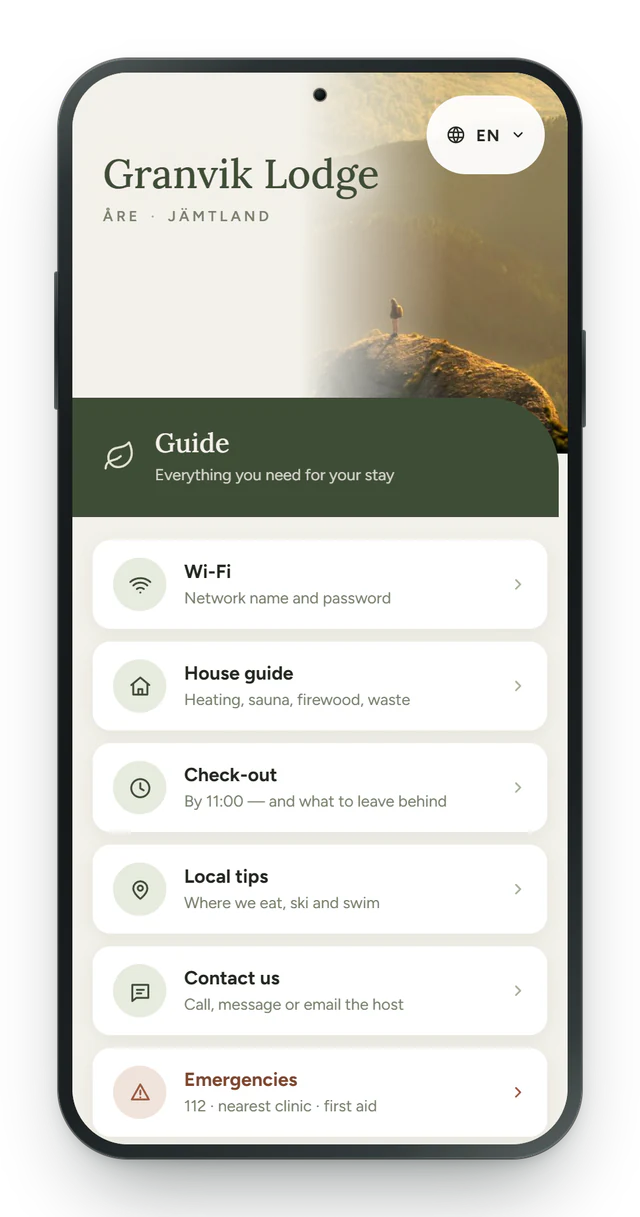
The theme is not a permanent decision. Changing it later does not touch your content, and it does not change the address or the printed code.
Step 6 — Publish it behind a permanent code
This is the step that determines whether the guide is still working in two years.
Every accommodation in QRiousStay has a permanent QR code and a readable web
address. The code points at the accommodation, not at a snapshot of its
contents — so editing the guide, changing the Wi-Fi password, adding a service
or switching theme changes what a guest sees at the next scan without touching
the sign on the wall. You can rename the readable address
(qriousstay.com/cabins/your-name) whenever you like and the printed code is
unaffected.
This is the difference between a code that is an asset and a code that is a liability. QR codes that survive the season explains what goes wrong with the other kind.
Step 7 — Print it and put it somewhere honest
A guide nobody scans is a document nobody reads. The sign is not an afterthought — it is the entire distribution mechanism.
QRiousStay’s QR Print Designer exports an A5 sign in one of six layouts at 300 DPI as PDF or PNG, with your accent colour, and your logo on Basic and Premium. Print it properly and put it where the question gets asked: by the door for arrival, in the kitchen for the appliances, by the hallway for everything else.
The physical craft has more to it than it looks — printing and placing your QR sign covers contrast, size, lamination and the placements that fail.
Step 8 — Read it as a guest, once, on a phone
Before you call it finished, scan your own code with your own phone, standing where a guest would stand.
You will find three things every time: something written for someone who already knows the house, something that has gone stale since you wrote it, and one answer buried three taps deep that should have been on the first screen. Fix those and stop. The guide does not need to be complete on day one; it needs to be correct.
A worked example, start to finish
Eight steps described is not the same as one guide built, so here is the whole arc on a single property. Granvik is invented — a two-bedroom cabin an hour outside a town, let to families in summer and to walkers in autumn — but nothing about the work is.
The inventory (step 1). Six weeks of messages, read back. Thirty-one questions, and after grouping them: the Wi-Fi password eleven times, how to work the sauna seven, where to park when the neighbour’s trailer is out five, bin day four, and the rest ones and twos. Two of those are not really questions — the Wi-Fi is on a card that falls behind the microwave, and the parking answer is “it depends”, which is why it keeps being asked.
The scope (step 2). Everything about being in the cabin, nothing about booking it. No prices, no availability, no arrival instructions that only apply to one booking. It is the house speaking, not the calendar.
The structure (step 3). Ordered by the stay rather than by the building: getting in, Wi-Fi, the sauna, house information, the kitchen, parking, house rules, walks worth doing, check-out. The sauna is third because it is the reason people book, and the parking answer is written as a rule with an exception rather than a paragraph of hedging.
The writing (step 4). Nine sections, none longer than four sentences. The sauna instructions are the longest because they are the only ones where getting it wrong is expensive.
The look (step 5). Warm Retreat, because the cabin photographs well and the theme leads with the photograph. This took under a minute and is the step it is easiest to spend an afternoon on.
Publishing (step 6). One accommodation, one permanent code. The address is set once; the guide behind it is edited freely afterwards and the code never changes.
The sign (step 7). A5, portrait, hung inside the door at eye height where a guest is already standing while taking their boots off. A second smaller card in the kitchen, next to where the Wi-Fi card used to fall behind the microwave.
The read-through (step 8). On a phone, standing in the hallway, pretending not to know the house. Two things failed immediately: the sauna section assumed you already knew where the switch was, and “the second drawer” turned out to be ambiguous from the doorway. Both were fixed in about four minutes, with no reprint, because the fix is behind the code rather than on it.
The first fortnight. The Wi-Fi question stopped. The sauna question did not, until the section was rewritten to start with the switch rather than the temperature — which is the difference between an answer that is missing and an answer that is hiding. The parking question became rare rather than gone, which is honest: some questions are about the world rather than about the guide.
The whole build was an evening. The read-through found more than the writing did, which is usually the way round.
What to do after the first week
Watch what happens. QRiousStay records when a code was scanned and which accommodation it belongs to — a total, a per-day trend, and the share across your properties if you have more than one. It deliberately does not record who the guest is.
That is a narrower signal than it sounds, and it is worth understanding what it can and cannot tell you before drawing conclusions from it: what scan data shows.
Then keep a note of every question a guest still asks you by message. Each one is a gap in the guide, and closing them one at a time is how a guide gets good. How to stop answering the same guest questions is the method.
Start with one accommodation
You do not need to plan the whole thing. A free account carries one accommodation, six standard services, your own language and a permanent QR with a printed sign — enough to put a real guide on a real wall and find out what your guests actually do with it.
The trial is fourteen days of Premium on one accommodation for new customers, and nothing you build during it is deleted when it ends. See what each plan includes.