

Guides · Languages
Building a guest guide in your guests' languages
Which languages to offer, how to write English that survives translation, and the sentences that go wrong when they are translated literally.
A guest reading house rules in their fourth-best language is not being rude when they break one. They are guessing, and guessing is what your guide asked them to do.
Offering a guide in other languages is one of the few changes to a guest guide with an obvious mechanism behind it: the guest understands the rule, so the rule holds. What takes a little thought is which languages, and how to write source text that survives being translated.
Step 1 — Find out what your guests actually read
Not what nationality they are. What they read.
Three sources, in order of usefulness:
- Your own booking history. Go back a season. Count the countries, and be honest about the long tail — four guests from one country over a year is not a language, it is four guests.
- The language your messages arrive in. A guest writing to you in careful, slightly formal English is often more comfortable in something else.
- Where your listing is shown. If a platform markets your property heavily in one region, that region is your next wave regardless of last season.
Most individual hosts land on two or three languages beyond their own, and a property in a border region or near an airport lands on more.
Step 2 — Choose the languages, not the flags
Two traps here.
A language is not a country. Offering “Belgium” means nothing; a Belgian guest reads Dutch or French. German covers Germany, Austria and much of Switzerland. Spanish covers far more than Spain.
Your own language is not one of the choices. In QRiousStay the guide’s source language — the one you write in — is always available and never counts against the number of translation languages you may offer. If you write in Swedish and offer English, German and Dutch, guests see four languages.
QRiousStay carries 129 translation languages, with up to three selectable on Basic and six on Premium. The first language you select is the default — what a guest sees before they choose — and that should be the language most of your guests read, which is not always your own.
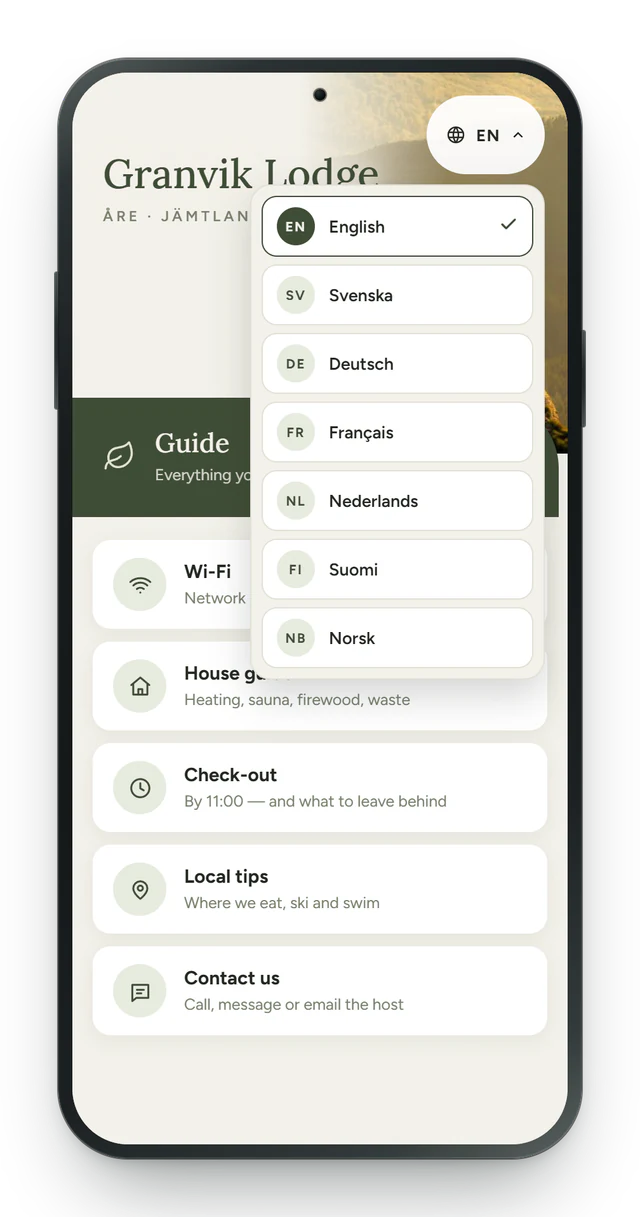
Guests choose their own language on the phone. You are not deciding for them; you are deciding what is on the menu.
Step 3 — Write source text that survives translation
This is the part hosts skip, and it is the part that determines quality. The translation can only be as clear as the sentence it started from.
Short declarative sentences. “Check-out is 11:00.” Not “We would kindly ask that all guests please vacate the property by 11:00 at the latest.” Politeness constructions translate into stiffness or, worse, into ambiguity about whether the rule is a rule.
One instruction per sentence. A sentence carrying three clauses gives a translator three chances to attach one to the wrong thing.
Avoid idiom entirely. “Give the door a good shove”, “the heating takes a while to get going”, “pop the key back through the letterbox” — all perfectly clear, all translate into something between odd and incomprehensible.
Be careful with bare labels. Single words out of context are where machine translation reliably fails, because it has to guess which sense you meant. This is not hypothetical: “Showers” in a weather forecast becomes the bathroom kind in several languages; “Clear” becomes vacant rather than cloudless; “Pay” becomes salary. If a label could mean two things, use two words — “Rain showers”, “Clear sky”, “Pay now”.
Write numbers as numbers. “11:00” survives everything. “Eleven o’clock in the morning” does not.
Name things exactly. Wi-Fi names and passwords must not be translated, and neither should proper nouns. If a network is called Fjällstugan Gäst, say so and do not explain it.
Step 4 — Decide what should not be translated at all
Some content is worse in translation:
- Wi-Fi network names and passwords. Always literal.
- Street addresses. A guest typing an address into a map needs the local spelling, not a rendering of it.
- Restaurant and business names. Give the local name; add a translated description beside it if the name is opaque.
- Emergency numbers. Digits, in the country’s own format.
A useful pattern for local recommendations: local name, then one translated sentence about what it is. The guest can say the name to a taxi driver and still knows why you sent them.
Step 5 — Check the languages you cannot read
You will not be able to review a translation into a language you do not speak, and pretending otherwise is how errors ship. Three checks you can do anyway:
Look at the numbers. Times, prices, phone numbers and Wi-Fi passwords should be identical to the source. If a number has changed, something is wrong.
Look at the length. German and Finnish run long, and a translation out of English is more often longer than shorter. A translated line that is dramatically shorter than the source has usually lost something.
Look at the proper nouns. Your property name, the street, the restaurant names should be recognisable. If your accommodation’s name has been translated into a common noun, fix the source so it reads as a name.
For the two or three languages that carry most of your guests, it is worth having one native speaker read the house rules and the check-out instructions once. Not the whole guide — those two sections, where a misunderstanding has a cost.
Step 6 — Set the default deliberately
The default language is what a guest sees in the first second, before they have found the menu. Some never look for it.
If most of your guests are German, the default should be German even if you wrote the guide in Swedish. The menu is there for everyone else.
What this is actually worth
The honest case for a multilingual guide is not that it impresses guests. It is that a rule understood is a rule followed, and an instruction understood is a message you do not receive.
The sections where this pays are narrow and predictable: house rules, check-out, anything with a safety consequence, and anything with a time on it. A guest who misreads a restaurant recommendation has a mediocre dinner. A guest who misreads the check-out time costs you a cleaning window.
What a language barrier actually costs a host goes into where the cost lands, and why it is usually invisible in reviews.
The practical order of work
- Write the guide well in one language. A bad guide translated is several bad guides. What to include is the checklist.
- Tighten the source: short sentences, no idiom, disambiguated labels.
- Choose two or three languages from your own booking history.
- Set the default to your largest guest group.
- Have a native speaker read the rules and the check-out once.
- Add languages as the bookings change — the printed sign never changes, so adding a language is a change to the guide rather than to the property.
The section where this matters most is the rules, because a rule is exactly the kind of sentence where a near-miss translation changes the meaning: writing house rules guests actually follow goes through the wording that survives the trip.
If you are starting from nothing, how to set up a digital guest guide covers the whole arc. If you already know which languages you need, the plans differ on how many translations you may offer — three on Basic, six on Premium, with your own language always included.