

Insights · Measurement
What scan data shows, and what it does not
A scan count is a narrower signal than it looks. Here is what can honestly be concluded from it, and the four conclusions that cannot.
Most guest-guide products advertise analytics. Very few say what the number means, which is unfortunate, because a scan count is a genuinely useful signal attached to a genuinely narrow one — and the gap between them is where hosts draw conclusions that are not there.
This is the boundary, stated plainly, starting with the part that is usually left out.
What is actually recorded
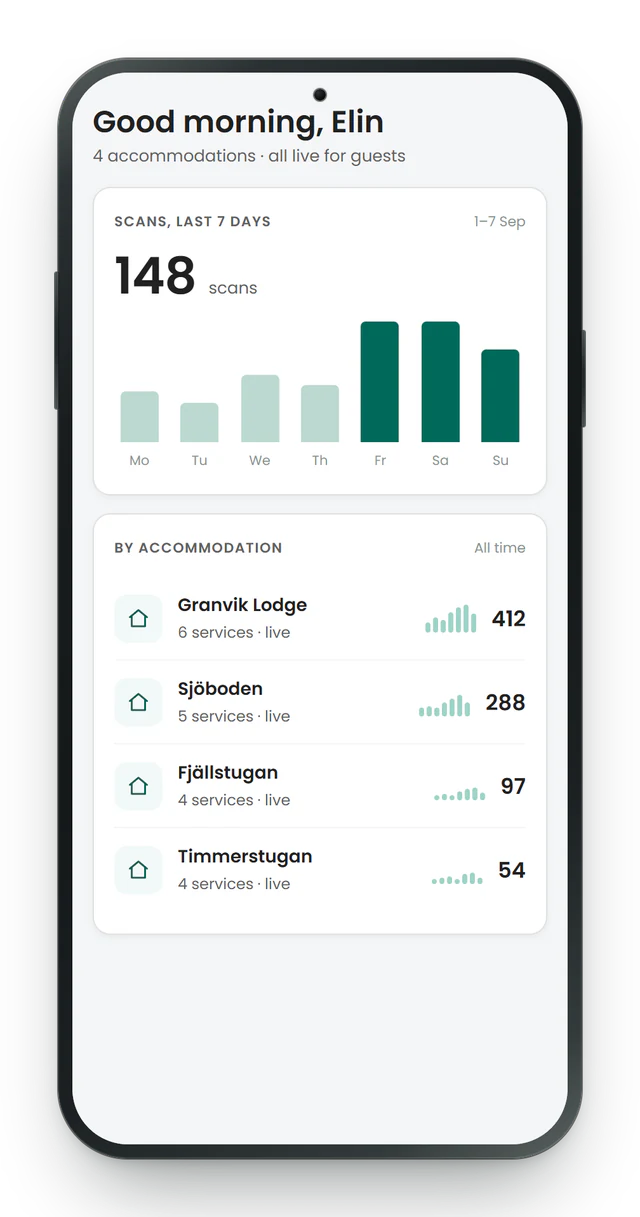
QRiousStay records when a code was scanned and which accommodation it belongs to. That produces a total, a trend over days, and — if you run more than one property — the share across them.
It deliberately does not record who the guest is. Not a name, not a booking, not an identity carried between visits. The guide opens in a browser with no account and no login, and there is nothing to attach a scan to a person with.
That is a deliberate limit rather than a missing feature, and it has a consequence worth stating before the useful part: several questions hosts naturally want answered cannot be answered from this data at all.
Four things a scan count cannot tell you
Whether the guest found what they were looking for. A scan is an opening, not an outcome. A guest who scans, hunts for four minutes and gives up produces the same single scan as one who finds the door code in three seconds. If anything, frustration produces more scans, not fewer.
Which section they read. The count is of the code, not of the content. A high scan count does not tell you the restaurant recommendations were read.
How many guests you had. One guest may scan five times across a week — once at the door, again for the Wi-Fi, again on the last morning. Another party of four may scan once between them, on one phone. Scans are not visits and are not people.
Whether the guide is good. This is the important one. Scans measure reach, not quality. A guide that is being opened constantly may be being opened constantly because nothing in it is findable.
Any vendor claim that analytics will show you guest satisfaction is describing something a scan count cannot do.
Three things it tells you clearly
Within those limits, the signal is real and there are conclusions it supports cleanly.
1. Whether the sign is working at all
This is the one the data is genuinely decisive about, and it is more valuable than it sounds.
If a property has eight stays in a month and four scans, the guide is not failing — it is not being found. The problem is physical: the sign is in the wrong place, too small, glare across it, or does not say what it is for. No amount of editing fixes that, and without the count most hosts would conclude their writing was at fault.
The inverse holds too. Scans roughly in line with the number of parties staying means the sign is doing its job, and any remaining problem is in the content.
When the count says the sign is at fault, the fixes are physical and mostly cheap: printing and placing your QR sign covers how large the code has to be for the distance it is read from, the colour combinations that quietly stop scanning, and the placements that look sensible and are not.
2. Whether a change to the sign worked
Because the count is coarse, it is good at large effects and useless for small ones. Moving a sign from the hallway wall to the kitchen counter is a large effect. Rewording the instruction line from “Scan here” to “Scan for Wi-Fi, check-out and local tips — no app needed” is a large effect.
Make one physical change at a time and compare across a month of comparable occupancy. Do not compare July to November and conclude anything.
3. Which properties are behaving differently
If you run several accommodations with similar occupancy and one has half the scans of the others, something is different about that property — almost always the sign or its position. The comparison between your own properties is far more informative than any absolute number, because everything else is held roughly constant.
The shape of a normal week
Two patterns show up often enough to be worth recognising.
Scans cluster at arrival. The largest share of scans in most properties happens within a few hours of check-in, which is why the arrival sign earns its place and why arrival information deserves the most care.
There is a smaller second cluster at departure. The last morning generates its own wave, looking for the check-out time and the list.
If your trend shows arrival scans and almost nothing afterwards, that is not necessarily a problem — it may mean the guide answered the arrival questions and nothing else came up. It may also mean guests gave up. The count cannot distinguish those, which is exactly the point of this article: the data tells you where to look, and your messages tell you what happened.
How to use it properly
Use scans as a reach metric and your own message history as the quality metric. They answer different questions and neither substitutes for the other:
- Scans low, questions high → the sign is the problem. Move it, enlarge it, add the instruction line.
- Scans high, questions high → the guide is being opened and is not answering. The problem is structure or wording.
- Scans high, questions low → working.
- Scans low, questions low → either your guests are unusually self-sufficient, or they are finding answers elsewhere. Worth asking one of them.
That two-by-two is most of the value. How to stop answering the same guest questions is the method for the two rows where questions are high, and it starts from your sent messages rather than from the chart, for the reasons above.
Why the narrowness is a feature
There is a version of this product that tracks guests properly — identity across visits, which sections were opened, how long each was read, a profile per guest. It would answer more of the questions above.
It would also mean that a person scanning a code on a kitchen wall, having given no consent and made no account, is being profiled. Guests scan because it costs them nothing. Collecting more would make that untrue, and the sentence “we record when a code was scanned and which accommodation it belongs to, and not who you are” would stop being sayable.
A coarse number you can state honestly is worth more than a precise one you have to explain. Read the count for what it measures — whether the sign is working — and take the rest from the questions your guests still ask.